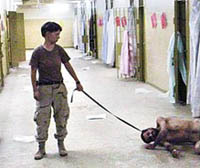
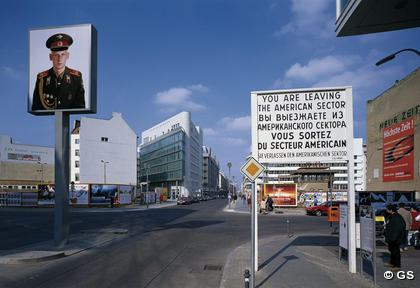
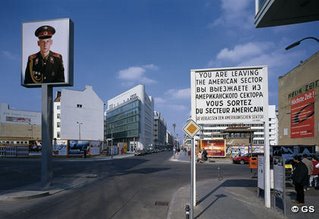
 "Checkpoint Charlie," the notorious gateway to Communist East Germany. Germany is now united, and Soviet-style checkpoints are now common in the U.S.
“You better stop runnin' your mouth, or the other officer will find a reason to lock you up tonight.”
In those words, recorded by Missouri resident Bret Darrow (my nominee for 2006 Whistleblower of the Year), we find perhaps the definitive snapshot of the Regime under which we live: Any armed agent of the Regime can contrive a reason to lock any of us up at whim.
Darrow, a shrewd but unassuming 19-year-old motorist, was stopped at a DUI roadblock in St. Louis last November. He was cooperative and non-confrontational when the officers enforcing that unconstitutional mass detention instructed him to provide his driver's license and proof of insurance. But he was singled out for exceptional detention when he presumed to behave as a free, law-abiding citizen.
(For a transcript of the episode, go
here. For the video, go
here.)
Specifically, when asked by an officer, “Where are you headed tonight?” Darrow replied: “I don't wish to discuss my personal life with you, officer.”
Ordered out of the car and forced to surrender his car keys, Darrow was told by an officer that he had to submit to an “interview ... because you didn't want to interview. You didn't want to sit down and have a talk with me.”
While this was happening, a second officer unlocked Darrow's 1997 Maxima and conducted an illegal warrantless search. A third tax-fattened hero, for whom manual transmission is a mystery as impenetrable as Fermat's Last Theorem, then got behind the wheel and attempted to move Darrow's car (the driver hadn't been permitted to move it out of traffic). In doing so, this good-enough-for-government-work drudge stalled the car repeatedly, seriously burning the clutch.
As the cops were illegally rifling through his property and vandalizing his car, Darrow was threatened with arrest for the supposed offense of asking why he was being detained.
“You're saying you're going to make up a reason to arrest me?” Darrow asked.
“No I didn't,” lied the officer. “I said we would find a reason.” He repeated that phrase a few seconds later. When Darrow asked again why he was being detained, the officer replied, “Because you don't have a driver's license” -- which was true only in the sense that it had been taken from Darrow by another officer.
Note this well: The mindset of the officers involved in this incident dictates that they can “find a reason” to send anybody to jail. It isn't necessary for an individual to commit a crime against persons or property, or even an offense against what is considered good public order. All that is necessary is for an agent of the State to decide that an individual is insufficiently submissive.
This symbolic function of a checkpoint -- providing a tangible reminder to the public that anybody can be deprived of his freedom at any time -- is its chief practical value to the Regime (although there are ancillary benefits for local franchises of the Homeland Security State, the most obvious being easily obtained revenue).
I've made this point before, adverting to the observation by author Richard Ben Cramer referring to the use and purpose of security checkpoints in Israel and the Palestinian Territories: "The function of the checkpoints is to show who's boss." In his book How Israel Lost, Cramer describes a conversation with an Israeli soldier newly arrived from Russia (and who, like most such immigrants, is almost certainly not Jewish). Cramer inquired why checkpoint guards routinely stop people who are obviously neither criminals nor potential terrorists.
The guard replied: "Because the bad attitude -- you know? If they are acting like they are good, and we are the bad one. Then, you must show them control."
This is the mantra of the checkpoint guard:
You must show them control.
You must make them submit.
You must force them to recognize the innate superiority of those who represent the Almighty State.
This is the real function of checkpoints, wherever they exist. And the mindset of checkpoint guards is the same, whether in Israel, your nearby airport, or your local sobriety stop.
One motorist in Elgin, Illinois collided with that mindset a few days ago. Angry over being stopped without cause and issued a $20 ticket for a seatbelt violation, the motorist honked his horn and began “blasting his tunes.”
This act of defiance – understandable to those of us on the receiving end of the State's harassment – provoked the officer issuing a ticket to “find a reason” for additional deprivations of liberty and property.
Elgin Police Officer Matt Udelhoven, who “often runs patrols looking for cars violating Elgin's loud music ordinance, went and got a laser gun that measures distance, walked about 150 feet away, and determined he could still hear the man's stereo,”
reported the
Elgin Courier News. Accordingly, he slapped the protesting motorist with a $250 fine and confiscated his car, which most likely means that the driver will be stuck with $250 in towing and impound fees.
“He got home in a hurry – on foot,” smirked Lt. Jeff Adam, who – like any other bully who taunts a helpless victim – really deserves to lose a few teeth.
TheNewspaper.com, a truly indispensable resource,
points out that the seizure of the motorist's car was entirely illegal:
“Elgin Police cited the city's noise ordinance which applies to those who are `operating' a vehicle – the motorist was parked – and is designed to protect citizens against `excessive noise endangers physical and emotional health and well-being.'”
So the seizure of the car was an act of armed robbery, just as the damage to Bret Darrow's Maxima was the result of armed vandalism.
The Elgin motorist, continues TheNewspaper.com, “can only challenge the seizure by first arguing his case before the deputy police chief in a hearing where `the formal rules of evidence will not apply.' The next hearing happens up to 45 days later under civil procedures that are used so that Elgin can escape the due process protections of the Constitution such as the Eighth Amendment prohibition on excessive fines.”
Notice a family resemblance to the “extraordinary” judicial procedures developed to deal with the “war on terror” -- special courts that can write their own rules, and ignore those rules altogether when it suits them?
These are not “extraordinary” measures. This is standard operating procedure for the Regime that rules us.
What do we do about it?
First of all – to reiterate a point I've made earlier – people have to understand that we no longer have local police. We have local affiliates of a centralized Internal Security force. Many have warned for decades that this process was underway, but they shrink from admitting now that it's a
fait accompli.
At some point, after the churn has operated long enough, what was once milk has become butter.
Secondly, all of us need to investigate the strands of subsidy binding our state and local police to the Feds – for sobriety checkpoints, seatbelt and child safety seat inspections, and – particularly – for narcotics enforcement. At least some of the same people who are stolidly indifferent to large-scale abuses of civil liberties (extraordinary rendition, the Military Commissions Act, and the like) committed by the Regime's apex authority can be riled up very easily over more commonplace abuses of the sort inflicted by the Regime's local appendages.
Political remedies for these outrages – assuming that such exist -- will have to be obtained at the Statehouse and at City Hall, and will only come when a sufficient number of sufficiently angry people are mobilized to deal with specific policies. Find the nexus between local police harassment and federal money; use local media to educate the public about the fact that these policies aren't being driven by local problems, but rather by federal subsidy and the corrupt opportunism of local authorities.
Third, Bret Darrow's experience – like
the horrifying UCLA Taser incident – illustrates the value of documenting every encounter with law enforcement officers (LEOs). As we've seen, LEOs are indoctrinated to see the public as a pool of criminals, whose daily behavior offers plentiful reasons for imprisonment.
We should reciprocate by assuming that every LEO, every day, commits offenses against the civil liberties of the law-abiding – and be prepared to document the fact if the opportunity presents itself.
Should this happen – and we shouldn't be out borrowing trouble – we should display the same polite composure exhibited by Darrow during his unfortunate encounter.
This approach is complicated somewhat by the fact that at least some police agencies are willing to arrest people for “obstruction of justice” when they use cell phones or other devices to record police activity. Witness
the case of Philadelphia resident Neftaly (Neffy) Cruz, whose home was invaded and who was arrested when he used his cell phone to take a picture of a police roadblock.
“[The arresting officer] opened up the gate and ... he went out to Neffy, pulled him down, had Neffy on the car and was telling him, `You should have just went in the house and minded your own business instead of trying to take pictures off your picture phone,'” recalled neighbor Gerrell Martin.
Cruz later recalled that the police “threatened to charge me with conspiracy, impeding an investigation, obstruction of an investigation ... They said, `You were impeding an investigation.' [I asked] `By doing what?' [The officer said] `By taking a picture of the police officers with a camera phone.'”
Of course, no law prohibits anybody from taking a photograph of a police officer, or anyone else.
But as Darrow was pointedly warned, if LEOs want to do so, they can “find a reason” to put you in jail.
A tragic postscript, courtesy of the redoubtable Radley Balko:U.S. Army Reserve Corporal James Dean was killed last Tuesday by a sharpshooter from a southeast Maryland SWAT team. Despondent over the prospect of being redeployed to Iraq, Dean became suicidal. So the Regime's local affiliate dispatched a paramilitary team to ensure that Dean got his wish.
It should be obvious, but I'll say it anyway: This kind of thing just doesn't happen in a genuinely free country.