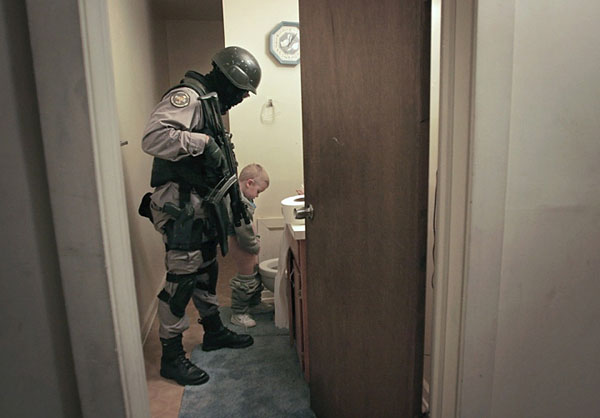
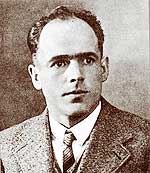
The persistence of evil: An aging adherent of Stalin's personality cult loves him some Big Brother.
During the Moscow Show Trials of the late 1930s, Soviet prosecutors ran across one particularly recalcitrant subject who simply refused to confess. The man maintained his innocence despite the demonic inventiveness of the tormentors who employed what the Bush regime calls “coercive interrogation” methods to break him down.
Granted, the interrogators could simply have treated him to a “Lubyanka breakfast” -- a cigarette and a bullet to the back of the head. But without a confession, the entire exercise would have been sterile at best, and counter-productive at worst. The entire point was to extract a confession, and to display the broken defendant to the public as evidence that the state was both infallible and pitiless. It simply wouldn't do to execute a man who defiantly insisted on his innocence.
Perplexed and anxious, the lead prosecutor sought and was granted an audience with Stalin, who listened intently. After the prosecutor finished describing the troublesome case, Stalin sat in quiet thought for a moment before asking an unexpected question of the increasingly agitated prosecutor.
“How much does the State weigh?” asked the Soviet ruler in a disarmingly gentle voice. “All of the buildings, the farms, the weapons and equipment? All of the officials, police, soldiers, and prosecutors?”
The prosecutor, who by this time was probably about to suffer a stress-induced coronary, replied that he didn't know the answer, and doubted that anybody could know.
“How long could one man hold the weight of the State on his back?” Stalin persisted, his voice still atypically mild.
“Comrade Chairman, no man could bear the weight of the State for an instant!” answered the prosecutor.
“Exactly,” replied Stalin, his voice suddenly transposing into a quietly threatening register that induced a perceptible chill in the room. “Remember this well, and go back and get that confession.”

The very model of the modern prosecutor: A.Y. Vyshinsy was chief prosecutor at Stalin's Purge Trials in the late 1930s, before going on to be a co-author of the UN Charter. His approach to prosecution -- assuming that everybody is guilty of something, he worked to extract confessions that enhanced the power and prestige of the state -- is followed by most American prosecutors today.
Please forgive me if the details of that incident aren't exactly right; it's been a quarter century since I first read that story. I was prompted to remember that story by the most recent batch of headlines describing the fact that the United States of America has an unassailable lead over the rest of the world – including such havens of liberty and justice as Communist China and post-Soviet Russia – in the field of incarceration.
Citing the International Center for Prison Studies at King's College in London, former Assistant Treasury Secretary Paul Craig Roberts points out that “the US has 700,000 more of its citizens incarcerated than China, a country with a population four to five times larger than that of the US, and 1,330,000 more people in prison than crime-ridden Russia. The US has five percent of the world's population and 25 percent of the world's prisoners. The American incarceration rate is seven times higher than that of European countries.”
One of every 32 adult Americans is either imprisoned, on parole, or on probation. Roberts is of the opinion – a point of view he has ably defended in his extremely valuable book The Tyranny of Good Intentions – that a very high percentage of the prison population consists of people who have been wrongfully convicted. This isn't because our jury system is useless, but rather because “hardly any of the convicted have had a jury trial. No peers have heard the evidence against them and found them guilty. In the US criminal justice (sic) system, more than ninety-five percent of all felony cases are settled with a plea bargain.”
In elaborating on this point, Roberts describes what can properly be described as a neo-Stalinist “justice” system in which the central objective is to validate the State's infallibility – albeit through pre-trial allocution by the defendant, rather than a successful trial -- and career-minded prosecutors have long abandoned any pretense of being interested in justice:
“Any defendant who stands trial faces more severe penalties if found guilty than if he agrees to a plea bargain. Prosecutors don't like trials because they are time consuming and a lot of work. To discourage trials, prosecutors offer defendants reduced charges and lighter sentences than would result from a jury conviction. In the event a defendant insists upon his innocence, prosecutors pile on charges until the defendant's lawyer and family convince they defendant that a jury is likely to give the prosecutor a conviction on at least one of the many charges and that the penalty will be greater than the negotiated plea.”
Accordingly, our “justice” system at present “consists of a process whereby a defendant is coerced into admitting to a crime in order to escape more severe punishment for maintaining his innocence. Many of the crimes for which people are imprisoned never occurred. They are made up crimes created by the process of negotiation to close a case.... What we have today is a conveyor belt that convicts almost everyone who is charged.”
Once again, a fuller understanding of the process Roberts describes is offered in his book, which outlines the abandonment of our Anglo-Saxon tradition of individual rights through the rule of law in favor of a version of Jeremy Bentham's evil collectivist doctrine of utilitarianism (the “greatest good for the greatest number,” as “good” is defined by a supervisory elite).
But a good and sufficient illustration of the truth of Roberts' indictment of our “justice” system can be found in the case of Richard Paey, a wheelchair-bound 48-year-old father of three serving a 25-year prison sentence in Florida for the supposed crime of asserting his innocence. About two and a half years ago, Paey – who is in chronic severe pain as a result of injuries suffered in a car accident, and exacerbated by an inept surgery and the subsequent development of multiple sclerosis – was convicted of fifteen counts of drug trafficking, obtaining a controlled substance by fraud, and possession of a controlled substance.
The “drugs” in question were painkillers Paey obtained in Florida with the help of Dr. Steven Neurkowicz, his family's former physician in New Jersey. Paey claims that Neurkowicz wrote him the necessary prescriptions; this account was validated by Florida pharmacists during his trial, and in Neurkowicz's initial testimony.
However, the prosecution was able to terrorize Neurkowicz into changing his story through the simple expedient of threatening to take away his practice and face a 25 years-to-life sentence for over-prescribing painkillers.
Neurkowicz, already rattled by the paramilitary raid on his office in New Jersey (Paey's family received the same jackboot-on-the-neck treatment in Florida), agreed to testify against the crippled man in court.
Following standard procedure, prosecutors offered Paey a deal: Eight years' probation, including three years of house arrest, if he were to plead guilty to attempted drug trafficking. Insisting that he had done nothing wrong, Paey refused that deal, and subsequent offers – including one that would have reduced the charges against him in exchange for testimony against Dr. Neurkowicz.
It took three tries for the prosecution to convict Paey. The first attempt ended in a mistrial; the second in a conviction that was thrown out because of a procedural error.
The third trial resulted in a guilty verdict, despite the fact that the prosecution admitted that Paey didn't sell or otherwise distribute the painkillers. Under Florida's laws, however, possession of more than 28 grams of painkillers is sufficient to provoke a charge of drug “trafficking.” Accordingly, the jury – owing largely to false assurances by the jury foreman that a guilty verdict would result in probation – voted to convict. After the trial, one juror told the press that he voted guilty in order to avoid being the sole holdout.
Displaying the soul (if that's the correct word) of a Stalinist prosecutor, Florida Assistant State Attorney Mike Halkitis declared after the trial: “It's unfortunate that anyone has to go to prison, but he's got no one to blame but Richard Paey. All we wanted to do was get him help.”
You're a damned liar, Mike – a gelded, sycophantic, metrosexual liar. The same is true of your comrade Scott Andringa, the prosecutor who presided over the “trial” of Paey, who told New York Times columnist John Tierney that he was “proud that I did my job as a prosecutor” in sending an innocent man to prison.

Drug war casualty Richard Paey: Although confined to a wheelchair, he stands much taller than the corrupt, tax-engorged drones who sent him to prison.
Your “job” was to get a crippled, pain-wracked man to submit to the power of the State – and you lost. He's in prison, with his integrity intact. You're not physically imprisoned, but as hostages to professional vanity and corrupt ambition you're not free men, or men of any kind. If either of you were any part of a man, you would resign your positions and work tirelessly to rectify the injustice you wrought on this innocent man and his family.
Now that he's in prison, Paey is actually receiving – courtesy of the same state that imprisoned him – a larger daily dose of painkiller than he had been consuming “illegally” before his trial. Of course, this blessing comes with conditions.
Radley Balko, in an October 24, 2005 piece for National Review, pointed out that following a July interview with the Times' John Tierney, which resulted in piece sympathetic to Paey and critical of the State of Florida, “prison officials retaliated” by moving Paey “to a prison facility more than two hours from his wife and family. He was then moved even farther away, some 170 miles, to the Tomoka Correctional Institution near Daytona Beach. Sympathetic prison officials, other inmates, and medical staff have since told Paey he was moved away from his family because the guard who sat in on his interview with Tierney had complained to prison authorities about what Paey had revealed to the journalist.”
At the same time, medical staff at the prison told Paey they had been denied permission to refill the morphine pump attached to his wheelchair. For several weeks Paey lived under “the equivalent of a death sentence” -- actually, something much worse, given the unbearable agony he confronted if the morphine were to be cut off – before the prescription was filled literally hours before his pump ran dry.
Last week, Florida's Second District Court of Appeals refused to overturn Paey's sentence, insisting that while the sentence was manifestly unjust, the proper course would be to appeal to outgoing Florida Governor Jeb Bush for executive clemency.

Mercy is for the privileged: Noelle Bush, daughter of Florida Governor Jeb Bush, was arrested and charged with an offense similar to the one for which Richard Paey was sent to prison for 25 years. Because she was born into the royal family, Miss Bush was referred for drug treatment.
Jeb Bush's daughter Noelle, incidentally, was also found guilty of prescription tampering. She was referred to a drug treatment program.
The ruling in Paey's appeal prompted an incendiary dissent by Judge James Seals:
“I suggest that it is unusual, illogical, and unjust that Mr. Paey could conceivably go to prison for a longer stretch for peacefully but unlawfully purchasing 100 oxycodone pills from a pharmacist than had he robbed the pharmacist at knife point, stolen 50 oxycodone pills which he intended to sell to children waiting outside, and then stabbed the pharmacist.”
But Judge Seals is making a category error here by assuming that the purpose of the law in proto-Soviet America is to punish crimes against persons and property. An armed robber behaving as Seals describes, after all, would not be defying the power of the State. This is why the State wouldn't deposit the entire weight of its coercive apparatus on the back of that criminal, as it did in dealing with Richard Paey.
Point of Personal Privilege
Last week I received several donations from some incredibly generous people. You know who you are, and I intend to thank you individually, but for the record, I want to let you -- and my other readers -- know how deeply grateful I am. The help was timely and very much appreciated. God bless you.
On a less pleasant subject:
I really don't want to return to the subject of my termination by the JBS, but numerous inquiries received during the past couple of weeks -- and the increasingly bizarre stories that are being told about me -- make it necessary for me to clarify some important points.
Point one: I did not quit. I was involuntarily terminated.
Point two: At no time subsequent to my termination was I approached by JBS leadership to open "negotiations" with a view to bringing me back on the staff. Various third parties have offered to act as intermediaries in such discussions, but none of those overtures was made on behalf of JBS leadership.
Point three: I have not been sued by anyone for anything I have written here or anywhere else.
One reader informed me this morning that his local coordinator "asked his boss how the `negotiations' were going on to get you back. He was told that those had ceased as you had now gone off and gotten yourself sued.... He said that the JBS legal staff did not want to consider hiring you now since it would bring all kinds of legal ramifications on them as well."
There is not a molecule of truth to that account. Furthermore, the official letter of termination I received on October 3 says nothing about concerns over the
"legal ramifications" of what I've written here; had such concerns existed, they would certainly have been mentioned in that letter, or in the conversation I had with the JBS CEO on the previous day.
The official reason I was fired, as explicitly described in the October 3 letter from JBS CEO Art Thompson, was my refusal to take down this personal blog, apologize for everything I have written herein, and submit everything I write or say in public to JBS leadership for pre-approval. That refusal, according to the letter of termination, constituted a breach of "responsibility to [my] employer."
I've used this blog to tell the truth as I've been given wisdom to understand it. This was unacceptable to my former employer, which now apparently expects its field staffers (who, it must be said, are not privy to the relevant details) to retail untruths about the reasons I was fired.
Since the people I'm referring to are friends, I hope I'm wrong in that perception. However, given the extent to which the misrepresentations have been circulated, I'm left without a suitable alternative explanation.
Members and staffers of the JBS who want to learn more about this should contact me directly at WNGrigg@msn.com.