Sunday, June 8, 2014

A Former Hammer's Lament: It's No Fun to be the Nail


Sandy, Utah resident Mark Shurtleff was thousands of miles away when he received the news that his son and daughter had joined the ever-growing ranks of Americans whose homes have been violated, and families have been terrorized, by SWAT raids. 

The Berserkers who invaded his home “showed up in masks,” Shurtleff protested, relaying the account provided by the victims. A dozen officers wearing body armor and carrying assault rifles “burst through the door screaming and yelling at my kids.”

Shurtleff’s 17-year-old daughter was in the bathroom when the strangers in body armor burst in and painted her body with the laser sights of their assault rifles. The raiders – a combined force of state police and FBI agents -- “trashed” the home, Shurtleff insisted, seizing the children’s computers and memory cards from his wife’s digital camera. They also intimidated his 20-year-old son into providing them with computer passwords and the key to the family’s gun safe. 

“These John Wayne wannabes, freakin’ Clinton Eastwood `Dirty Harry’ tactics were absolutely unacceptable and unneeded,” Shurtleff complained on a local talk radio program. He characterized their behavior as “recklessly negligent,” and accused Scott Nesbitt, the chief investigator who presided over the raid, of making deliberate misrepresentations in the affidavit that resulted in the search warrant.

“When I’m cleared … and I will be cleared, there will be accountability and there will be liability on the part of these people,” Shurtleff promised. 


The invasion of Shurtleff’s home followed a similar raid on the home of fellow Utah resident John Swallow. Neither of them is suspected of a violent crime. The treatment they received is increasingly commonplace in Utah and elsewhere in the Soyuz, but Shurtleff and Swallow were somewhat uncommon targets. Shurtleff served for twelve years as Utah’s attorney general. Swallow was his successor; he was forced to resign amid scandal after less than a year in that position. Shurtleff and Swallow are under investigation for suspected violation of campaign finance laws. 

Complaining that the investigation had injured his reputation, damaged his career prospects, and traumatized his family, Shurtleff insists that he is “done standing back and being quiet.”

“I think if they’ll do that to me, with my entire life and career in service to law enforcement and public safety, they’ll do it to anybody,” Shurtleff declares, speaking with the incontestable credibility of someone who made a career out of ruining lives and terrorizing the helpless. 

“He knows our procedures, he knows how we operate – this should come as no surprise to Mark Shurtleff,” observed Juan Becerra, a former FBI agent who had carried out SWAT raids carried out during Shurtleff’s tenure as attorney general. “He knows what all law enforcement procedures are because they’re common across the board.”

As in all encounters between the state’s credentialed emissaries of violence and the public upon whose honest income they prey, the primary emphasis during a “door kick” is the sacred imperative of officer safety.
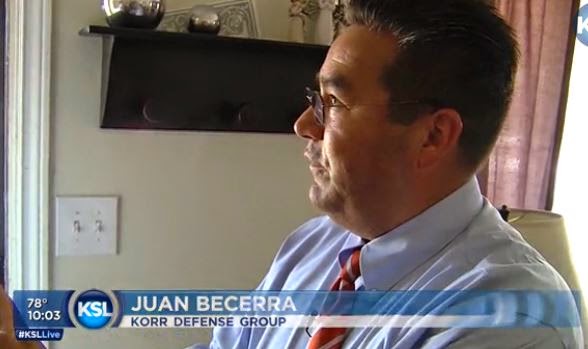

Police who invade a home enter “with authority,” explains Becerra, invoking the statist shibboleth used to sanctify aggressive violence. “What you don’t know is what’s on the other side of the door.”

As it happens, behind the bathroom door in the Shurtleff home was a tiny 17-year-old girl.

“They burst [in on] my little girl – my 17-year-old – going to the bathroom, screaming at her to get out of there,” recalled Shurtleff. “When she steps out there are four men in body armor with weapons pointed at her chest.”

Shurtleff described the assault on his home and children as “unlawful.” The Utah State Police and FBI insist that the raids were carried out in strict compliance with the standard operating procedures that were followed during Shurtleff’s reign as attorney general – during which he saw nothing amiss in the deployment of a platoon-sized contingent of fully militarized officers to attack a an outdoor concert in Spanish Fork Canyon. This took place in August 2005, about four and a half years into Shurtleff’s term.

Utah County resident Trudy Childs and her family are owners of the “Smoky Mountain Ranch,” which would be leased to concert promoters for summer music events. This was done with the understanding that the promoter would comply with county ordinances dealing with public assemblies of 250 people or more.  The Childs and their business partners obtained all of the proper permits, hired EMTs, and otherwise crossed all of the myriad t's and dotted all of the requisite i's. 


The Utah County Sheriff’s Office, burdened with puritanical conviction that any gathering of young people must involve improper conduct, carried out two raids during the summer of 2o05 – one on July 16, the second on August 20th. 

The second assault, according to Mrs. Childs, involved “armed and battle-ready uniformed SWAT officers, deputy sheriffs, and other law enforcement officers” as well as the deployment of a helicopter for air support. In a subsequent lawsuit, Mrs. Childs recalls that despite being the owner of the ranch she was “ordered off the land by officers during both raids. During the second one she was arrested without legal justification “because I questioned the authority of the officers to stop the concert and order me off the property.”

Prior to the concerts, the Utah County Sheriff’s Office dispatched undercover officers to purchase controlled substances, which – as anybody with a scintilla of knowledge about popular music culture knows -- are frequently available at such events. This provided the police with an excuse to describe the event as an illegal “rave.” 


Few things more readily bring to the surface the latent heroism and sheer martial prowess of a police officer than the prospect of beating down a skinny, unarmed, terrified teenager. Mark Shurtleff’s teenage daughter can attest to this on the basis of personal experience. The same was true of the concert-goers who were on the receiving end of the August 2005 SWAT raid that Shurtleff found to be unobjectionable.


One performer who witnessed that blitzkrieg described seeing “a guy dressed in camouflage … toting an assault rifle…. A few `troops’ rushed the stage and cut the sound off and started yelling that everyone `get the f**k out of here or go to jail!”

Some of the Jackbooted intruders held leashes restraining drug sniffing dogs. One of them “alerted” to a concert-goer, who was attacked by four of the officers who “kicked him a few times in the ribs and had their knees in his back and sides,” the witness recounted. Another dog attacked a small, terrified teenage girl: “As she struggled to get away from it, the police tackled her. Three grown men proceeded to kick her in the stomach.” Similar accounts were offered by other eyewitnesses. Scores of attendees were arrested, the youngest of whom was 15 years old. 

Seeking to justify this atrocity, the Utah County Sheriff’s Office described it as a didactic exercise. “Police want parents of teenagers to know the dangers of illegal, clandestine rave parties,” explained the Salt Lake Tribune, reciting from an official press release. The chief danger of such gatherings, of course, is that they attract the malign attention of tax-fattened sociopaths looking for targets of opportunity. 


In this case, the raid not only offered SWAT operators a chance to kick ass in an entirely risk-free environment, it was an overture to an attempted land grab. 

Following the August 20th SWAT attack, the Childs, who had planned to hold a benefit concert in 2006, received a snotty letter from Stephen Sorenson, the gelded hack who served at the time as acting US attorney for Utah.

“The United States has received information that you are again considering leasing your property for an outdoor music concert,” declared Sorenson. “If you choose to lease your land again for another similar event, we can assure you that there will be drug trafficking on your property. You property can be civilly forfeited to the United States if it is merely used for or facilitates the distribution of narcotics.” 

“The Childs think Sorenson's sudden interest in their concert plans stems from the federal government wanting to get its hands on their land,” reported the Salt Lake Weekly. “Just one day before the US attorney sent the latter ... Sorenson had telephoned the Childs' attorney to make an offer on their land on behalf of two federal agencies.” The Feds had coveted that property since 1990.

“If they don't want to sell the land, all they have to do is say so,” simpered Sorenson. “If they want to avoid the risk of criminal or civil liability, all they need to do is not allow the rave on their property.”

The Childs weren’t planning a “rave,” but rather a benefit concert for Parkinson's disease research. As Trudy Childs pointed out, politically favored figures aren't put through the same wringer into which she had been fed.

“I attended the Rolling Stones and U2 concerts [in 2005] at the Delta Center, and my guess is there were probably drugs being used and probably people under the influence of drugs at both those concerts,” she pointed out. “Why don't [the Feds] send a letter to Larry Miller [who owned the Delta Center and the Utah Jazz]?”

The obvious answer is that Miller (who has since passed away) didn’t have what the Feds – of whom the petulant fascist Stephen Sorenson was a perfect specimen – were interested in stealing at the time. 


None of this aroused the slumbering moral indignation of Attorney General Shurtleff, our newly minted paladin of civil liberties. The lawsuit filed by Childs and her associates was dismissed a year later. 

Shurtleff continued to confer his benediction on SWAT raids, including one carried out by a specialized task force that targeted video merchants suspected of copyright violations.
 
In February 2011, the Statewide Enforcement of Crimes by Undocumented Residents (SECURE) dispatched combat-equipped officers to raid warehouse and homes in search of pirated CDs and DVDs. 

“Piracy is stealing and it doesn’t just keep Lady Gaga and Angelina Jolie from making a few more dollars,” warbled Shurtleff, supposedly consumed with zeal over the plight of the creative community. “This crime affects artists, writers, directors, backup singers, stage crew workers and every taxpayer in the U.S.”

How, exactly, does music and video piracy injure “every taxpayer in the U.S.”? It doesn’t – but it does deprive the tax-consuming class of its cut. Leo Lucey, the tax-feeder who grandly styled himself the SECRURE Strike Force Commander, explained: “These pirated goods are being shipped by train, truck, and air. This means taxes and fees are not being paid.”
Shurtleff and his SECURE Strike Force commandos – at least some of whom were probably involved in the August 2005 raids that shut down a CD release party in Spanish Fork Canyon – received honorary gold records from the Recording Industry Association of America for their anti-piracy crackdown. 

As Attorney General, Shurtleff saw nothing exceptionable about using military tactics to execute warrants dealing with non-violent offenses. All of this occurred, of course, when he was part of the “who,” rather than the “whom” – when he belonged to the exalted fraternity of official coercion, before becoming a mere Mundane. 

Shurtleff's perspective on routine acts of state terrorism has changed in predictable ways now that he’s a nail, rather than a hammer.  

Obiter Dicta 

My thanks to Darryl Brown for suggesting this story.

Follow me on Twitter @BlarneyConCarne

Listen to, or download,  the most recent Freedom Zealot Podcast here. 


Dum spiro, pugno!


Thursday, June 5, 2014

"The Future is Too Good to Waste on Lies": Bowe Bergdahl's Moral Odyssey


Bowe Bergdahl and his mother, Jani.

“I can’t make up my mind to put the damn thing on again. I feel so clean and free. It’s like voluntarily taking up filth and slavery again….I think I’ll just walk off naked across the fields.”

John Andrews, a U.S. soldier in World War I who went AWOL, discusses his uniform in Three Soldiers by John Dos Passos


Trying to find their footing amid a gale-force outpouring of largely manufactured outrage, officials in Hailey, Idaho canceled their long-planned homecoming for Sgt. Bowe Bergdahl. They were understandably intimidated by the prospect of dealing with thousands of protesters who planned to besiege the tiny central Idaho town to demand the blood of a young man they now regard to be a deserter, and a father they consider a terrorist sympathizer.

To understand the kind of welcome the War Party has been preparing for Bowe and his family, it’s useful to consider the treatment given to the family of World War I-era conscientious objector John Witmer.

A Mennonite from Colombiana, Ohio who was denied a deferment by the local draft board, Witmer died from the Spanish Flu while stationed at Camp Sherman, Ohio. Witmer's lifeless body was returned to his hometown on October 10, 1918, where the family – his father Dan, his siblings, and his fiancee, Nola – was greeted by a silent crowd heavy with sullen disapproval for the “slacker” and his family.

Like thousands of others who shared his faith, John had been kidnapped at gunpoint from his family farm through the evil practice of conscription. The local draft board had turned down John's appeal for Conscientious Objector status, dishonestly assuring him that once he had taken the oath of enlistment he would be recognized as a CO and be given a non-combat assignment.

As with everything else of consequence that emerges from the lips, pen, or keyboard of a government functionary, those assurances were lies.

During wartime, explained Bernard Baruch, the head of the Wilson Regime’s War Industry Board, all “men, money and things” within the government’s claimed jurisdiction “suddenly become a compact instrument of destruction…. [T]he entire population must suddenly cease to be a congeries of individuals, each following a self-appointed course, and become a vast unitary mechanism." John Witmer, like many thousands of others, was designated a “slacker” because he persisted in the belief that he was not the property of the State. His refusal to  undergo military training forbidden by his religious convictions provoked violent reactions from his fellow conscripts, and led to a punitive re-assignment to a CO camp – a detention facility that was also used as a holding pen for German prisoners of war.

The weather turned colder, and influenza – one of the government's chief wartime imports from Europe – propagated itself throughout Camp Sherman.  John pleaded for adequate bedding and dry clothes, to no avail. The isolated, terrified young man contracted the Spanish Flu, from which he soon died.

John's body was returned in a flag-shrouded coffin. While most Americans would regard this as an honor, the Witmer family's convictions didn't allow them to make acts of allegiance to anyone or anything but God. There is a sense in which wrapping John's body in the US flag was one final proprietary gesture by the government that had stolen the young man from the family who loved him, the religious fellowship that had raised him, and the young woman who wanted to be his wife.

The crowd that had congealed at the train station to witness the arrival of John Witmer's body was acutely interested in the reaction of his Mennonite family. Most of the spectators knew that the Mennonites didn't support the war; their principled pacifism had provoked both curiosity and suspicion.

For a brief period, the Witmers enjoyed what could be called probationary sympathy from the crowd. But they quickly learned that few things are likelier to provoke sanctimonious violence from war-maddened Americans than a conspicuous lack of enthusiasm for killing foreigners whom the State has designated the “enemy.”

Slumping beneath a burden no parent should ever bear, Dan Witmer approached the coffin containing his son's body and carefully removed the flag. In doing so, he committed an act regarded as a sacrilege by adherents of the omnivorous idol called the State: Either out of innocent ignorance of, or commendable indifference to, the ritual called “flag etiquette,” Dan folded the banner as he would a blanket.

The crowd, deep in the throes of the psychosis called “war patriotism,” erupted in pious outrage.

“The mood of the onlookers turned from one of sympathy to hostility,” recounts Lily A. Bear in her book Report for Duty.

“Mennonites!” hissed one disgusted onlooker.

“Got what he deserved!” declared another of Dan's dead son.

“Traitor!” bellowed yet another outraged pseudo-patriot.

Someone hurled a stone that hit John's younger brother in the shoulder. A second stone, missing its target, landed at the feet of the mourning father. John's young sister Mary, puzzled and hurt by this display of murderous hatred, began to cry. After making arrangements for his son's funeral, Dan took his family home. This crowd, deprived of the hate objects that had given it cohesion, quickly dissipated.

This repellent spectacle, recall, occurred in a tiny Ohio town nearly one hundred years ago. In this age of saturation media and online social networking, the “homecoming” given the Bergdahl family would likely have been worse by several orders of magnitude.


“I will push for Bowe Bergdahl’s execution during the next Republican administration,” fumed South Carolina Republican agitator Todd Kincannon. “And his dad too. Those who commit treason need to die.” Kincannon’s sentiments are not an aberration.

Bowe’s detractors claim that his desertion cost the lives of U.S. soldiers sent to rescue him – a claim that plays well on talk radio but cannot be substantiated by casualty records. Given the fact that Bowe had expressed his growing misgivings to his superiors, the effort to locate him might have been less a rescue mission that an attempt to locate and re-assimilate a wayward drone who had exhibited troubling symptoms of resurgent individualism.

Like John Witmer, Bowe Bergdahl was raised in a deeply religious home. Unlike Witmer, Bergdahl was not a conscript. Like countless other young men, Bowe was lured into enlisting by a recruiter who cynically appealed to his idealistic and patriotic impulses, and offered lying assurances about the missions he would be required to carry out. Bowe was a committed and disciplined soldier who devoted what private time he had to refining his skills, conditioning his body, and feeding his mind, rather than indulging in recreational vice.
Once he arrived in Afghanistan, Bowe was immediately disillusioned by the corruption and cluelessness displayed by his superiors, the laxity and unprofessionalism of his fellow soldiers, and the criminal indifference to innocent lives that characterized the mission.
“The few good [sergeants] are getting out as soon as they can, and they are telling us privates to do the same,” Bowe informed his father in an e-mail. He decided to act on that advice immediately, explaining to his parents that “The future is too good to waste on lies.”

Bowe’s parents are Christians of the Calvinist persuasion who home-schooled him, instructed him in Christian ethics, and respected his independence of mind and sense of personal responsibility.


“Bowe was a young man with all the dangers of home-schooling – a brilliant and inquisitive mind, a crisp thinker, and someone who had never really been exposed to evil in the world,” recalls Phil Proctor, who was pastor of the Presbyterian Church attended by the Bergdahl family. “He [wanted] to determine whether the Christian faith was his own, or his parents’ and was doing a lot of exploring of ideas – never drugs or alcohol, but trying to be an outdoors/Renaissance type figure.”

When Bowe announced his enlistment in the US Army, Bob didn’t approve but also didn’t discourage him. When Bowe expressed his terminal disgust with the mission in Afghanistan, Bob offered the admonition: “Obey your conscience.”

By offering that advice, rather than rebuking his son or turning him in to his superiors as a potential “shirker,” Bob Bergdahl committed treason, according to his detractors, who insist that loyalty to the Warfare State trumps all other moral commitments.

Bowe’s parents never relented in their efforts to bring their son home. Now their relief over their son’s liberation, and their expressions of unconditional love toward him, are being depicted as evidence of disloyalty to the Regime and even hatred forAmerica.

“Bob felt (with some justification) that the US government was not going to engage with diplomatic efforts and so decided to try to free his son himself,” recounts Pastor Proctor. “He learned Pashtun and developed a lot of contacts in the Middle East. The Qatar connection is one that either originated with Bob or, at the very least, became very personally connected to Bob. Bob has, for quite some time, been saying that the closure of Guantanamo is integrally connected to the release of his son.”

In addition to placing his duty to his son above loyalty to the State, Bob Bergdahl’s offenses include learning the language of his captors and expressing the heretical view that God disapproves of death of Afghan children. Even Bob’s beard is presented as evidence of his supposed affinity for Islamic jihad, a charge that – if applied even-handedly – could justify a drone strike targeting the cast of Duck Dynasty.

Rather than being a jihadist sleeper cell, as they are being portrayed by War Party dead-enders, the Bergdahls are Christian individualists. Their moral universe is defined by the Two Great Commandments (that we love our Creator and love our neighbors as ourselves ) and biblical teachings regarding the reciprocal moral duties of parents and children. They do not place allegiance to the State above loyalty to their family – which to a statist is an unforgivable heresy.

Speaking on FoxNews, Dr. Keith Ablow – displaying the ideologically inspired certitude of a Brezhev-era Soviet psychiatrist – discerned “narcissistic” tendencies in the entire Bergdahl family. Bowe’s desire for adventure and self-directed nature indicate that “he can’t really serve the nation … because he’s serving himself.” Bowe’s individualism was a form of “addiction,” insisted Commissar Ablow, eliciting coos of thoughtful assent from the Fox News personalities interviewing him, one of whom was prompted to underscore the importance of “obey[ing] your commander, rather than your conscience,” which is a decidedly a pre-Nuremberg order of moral priorities .

Bowe’s incorrigible commitment to his conscience is to be expected, Commissar Ablow continued, given that Bowe was raised in a family displaying a tendency “to distance one’s self from institutions, to diminish the rule of law and to elevate the individual above all else.” The problem with the Bergdahls, Ablow suggested, was that they “don’t feel part of our country.” The exchange of five Gitmo detainees for “somebody who didn’t feel very American” resulted in “a tremendously psychologically dispiriting moment for our people,” summarized the putative doctor, who strikes me as the kind of person who would consider the public execution of the entire Bergdahl family to be a moment of communal healing.

For people in the grip of war patriotism, the proper role for Bob and Jani Bergdahl was described in Livy’s account of the Horatti, or sons of Horace. During one of the countless conflicts in Rome's early expansion, Horace's triplet sons volunteered to engage three brothers from a rival tribe on the battlefield. The victors would win, on behalf of their city-state, possession of a strategically crucial – and now long-forgotten -- village.

Rome’s opponents were killed in a battle that also claimed two of Horace’s sons. In the subsequent victory celebration Horace lost one of his daughters as well: She was killed by the surviving brother as punishment for her romantic dalliance with an enemy of Rome. Horace bore the losses stoically, as befitting a father who sought above all things the greater glory of the government that claimed him.


Under that model of “patriotism” – which inspired the totalitarian French Jacobins, as well as their ideological offspring in Italy and Germany – Bob Bergdahl’s duty was to chastise his errant son, and exhort him to be true and faithful in carrying out the State’s murderous errand. If Bowe were to be killed by Afghans defending their country, his parents were expected to regard their son as an exalted hero, and their irreplaceable loss as a holy privilege.

Bowe was hardly the first American soldier whose understandable disillusionment led him to quit while deployed overseas.
                                                              
“I cannot support a mission that leads to corruption, human rights abuse and liars,” wrote
Colonel Ted Westhusing, a West Point Graduate, Special Forces veteran, and devout Catholic husband and father, in a despairing e-mail to his family. “I am sullied. I came to serve honorably and feel dishonored. Death before being dishonored any more.”


A few hours later Col. Westhusing shot himself in the head, ending his life less than a month before his tour of duty was scheduled to end. In the fashion of “Doctor” Ablow, an Army psychologist who reviewed Westhusing's e-mails following his suicide determined that the Colonel was “unusually rigid in his thinking” and unreasonably committed to his moral code.

 Army Specialist Alyssa Peterson was also devoutly religious, a former Mormon missionary from Flagstaff, Arizona. Like Bowe and Bob Bergdahl, Peterson had what one friend described as an “amazing” ability to learn languages, an aptitude that helped her learn Arabic at the Army's Defense Language Institute. Spec. Peterson volunteered for duty in Iraq, where she was sent to help interrogate prisoners and translate captured documents at an air base in Tal-Afar.

And, like Ted Westhusing, Alyssa Peterson was driven to suicidal depression as a result of the role the regime forced her to play in Iraq.

“Peterson objected to the interrogation techniques used on prisoners,” summarized Reporter Kevin Elston, who was using the official euphemism for “torture.” “She refused to participate after only two nights working in the unit known as the cage. Army spokesmen for her unit have refused to describe the interrogation techniques Alyssa objected to. They say all records of those techniques have now been destroyed.”

Immediately after lodging her objections, Alyssa was reassigned and sent to suicide prevention training; her suicide note took ironic notice of the fact that the “prevention” training actually instructed her in the best way to kill herself.

“What right had a man to exist who was too cowardly to stand up for what he thought and felt … for everything that made him an individual apart from his fellows, and not a slave to stand cap in hand waiting for someone of stronger will to act?” asked John Andrews, a WWI-era deserter, in John Dos Passos’ novel Three Soldiers. It’s quite likely that Ted Westhusing and Alyssa Peterson asked that question of themselves. Bowe Bergdahl’s emails to his father make it clear that he was pondering that question at the time of his desertion.

Implicated in grotesque crimes against decency, Col. Westhusing and Spec. Peterson “deserted” through suicide. They were buried with honors, and their bereaved families received sympathy, rather than scorn. Rather than ending his life, or allowing it to be wasted in the service of lies, Bowe Bergdahl sought to reclaim it on his own terms – and this is why War Party fundamentalists are seeking to not only to imprison him, but to destroy his entire family.


Dum spiro, pugno!

Monday, June 2, 2014

The Baby-Burning Stormtroopers of Habersham County, Georgia


For the love of God, stop the insane drug war.


“I stand behind what our team did,” insists Habersham, Georgia County Sheriff Joey Terrell, referring to a 3:00 a.m. no-knock SWAT raid in which a 19-month-old child was severely burned by a flash-bang grenade. “There’s nothing to investigate, there’s nothing to look at,” continued the sheriff, relaying the conclusions of the County DA’s office and the Georgia Bureau of Investigation. “Bad things can happen. That’s just the world we live in.”

The world Terrell inhabits is one in which police – acting as righteousness incarnate – kick in doors at 3:00 am and hurl incendiary devices into homes in order to arrest people on suspicion of non-violent drug offenses. If an infant receives life-altering burns as a result of that incursion, this can't be laid at the jackbooted feet of his officers, the sheriff maintains. The fault resides with the alleged drug dealers, whom the sheriff denounced as people “who want to do the domestic terrorism and sell dope and make the money.”

An unnamed petty criminal who acted as an informant told Terrell’s task force that drug commerce had occurred at the targeted residence in Cornelia, and that armed men were acting as “guards.” However, the stormtroopers found no drugs in the house. The suspect they sought wasn’t present when the raiders kicked in the door. Nineteen-month-old Boukham “Bou-Bou” Phonesavankh and his parents were visiting from Wisconsin after their own home had been burned down. 

The informant whose “controlled buy” provided the pretext for the subsequent atrocity supposedly reported that there were no children at the residence. Having lost their home in Wisconsin in a fire, the family was in Cornelia visiting relatives in the hope of rebuilding their lives – only to find themselves on the receiving end of an act of state-sponsored terrorism.

“Everyone’s sleeping,” recalled Alecia Phonesavanh, the mother of the infant victim, describing her family’s encounter with Terrell’s ministering angels of divine justice. “There’s a loud bang and a bright light. The cops threw that grenade in the door without looking first, and it landed right in the playpen and exploded on his pillow right in his face.”

The Sheriff has indicated that any criminal charges arising from the burning of the infant would be added to the indictment against the alleged drug dealer. He has also insinuated that the parents are responsible for the near-fatal injuries suffered by their baby. This is in keeping with the “Collateral Murder” model of deflected responsibility: When the Regime’s hired killers slaughter or mutilate children, it’s the fault of the parents for living in a targeted neighborhood.

Terrell's pious condemnation of drug-derived profits conceals his role as a kingpin in a criminal syndicate that exists in murderous symbiosis with Georgia's criminal underworld: Sheriff Terrell is the key figure in the Mountain Judicial Circuit Narcotics Criminal Investigation and Suppression Team (NCIS), a federally funded task force that prowls a three-county region in search of cash and property that can be seized in the name of “asset forfeiture.”

Like other federally funded einsatzgruppen of its kind, the NCIS liaises with small-caliber criminals, such as the “confidential informant” who allegedly conducted a meth transaction at the home where Terrell's minions later carried out the raid. Funding for the NCIS comes from a federal Byrne Grant, which is administered by the Habersham County Commissioners' office.

Terrell, along with Stephens County Sheriff Randy Shirley, is responsible for hiring, training, and deploying undercover NCIS officers, and bears command responsibility for the actions of the task force's tactical team. When the raiders carried out the 3:00 am raid in which 19-month-old “Bou-Bou” was nearly burned to death – the grenade “blew open his face and chest,” his anguished mother recalled – they acted as extensions of his will, and he shares culpability for their crimes.

In his first public comments following the attack that nearly killed Bou-Bou, Sheriff Terrell emphasized that the County DA and Georgia Bureau of Investigation had already “investigated” the incident and ruled that the actions of the SWAT team were “justified.”  While the sheriff offered perfunctory and grudging expressions of sympathy for the infant victim and his family (“I don’t think [the burns] cover a significant amount of the face or the chest,” Terrell said of an infant who was in a medically induced coma), he described in detail the trauma he insists was suffered by his stormtroopers, the people he obviously considers the real victims.

The officer who threw the grenade “is basically upside down,” relates the sheriff. “He’s gone and talked to his pastor, trying to get some counseling and some debriefing just to help him get through what has happened.” If that pastor is a man of God, rather than an agent of Leviathan, he will prescribe abject repentance in sackcloth and ashes.

Matt Wurtz, the on-site commander of the goon squad that raided the home, was similarly devastated, Terrell continues, but in a “trembling” voice expressed his determination to continue kicking in doors at 3:00 a.m. “because children are getting involved in situations they don’t need to be.”
That’s right: The on-site commander whose subordinates nearly burned a child to death in a raid the likes of which the Gestapo might have regarded excessive did it For The Children.

Sheriff Terrell likewise remains committed to pursuing the path of righteousness:
"We’re called for a purpose. The members of this team want to be here… We’re getting more and more information about children, 14-15 years of age, getting into methamphetamine. Who is going to stand up for them? Who is going to do the right thing? We are! We are! And we are not going to stop what we do.”

One wonders if the “information” to which Sheriff Terrell refers is as reliable as that provided by the “confidential informant” who told police that there were no children at the home prior to the SWAT raid.
Although Bou-Bou's prospects for survival are improving, it's quite likely he will be permanently disfigured as a result of the ministrations he received from Terrell's angelic emissaries of justice. The son of former Livonia, Georgia resident Jonathan Ayers, however, suffered an injury that cannot be repaired: He hadn't been born when NCIS officers murdered his father, a 28-year-old Baptist minister, on September 1, 2009.


Ayers was shot and killed by Officer Billy Shane Harrison outside a convenience store in Toccoa, Georgia. Harrison was one of three undercover NCIS operatives who pulled up in an unmarked black SUV and – with guns drawn – surrounded Ayers’ vehicle after the pastor had made a withdrawal at a nearby ATM.  The undercover cops looked like private sector thugs, and Ayers understandably thought he was dealing with carjackers His dying words at a local hospital made it clear that he didn’t know that the gun-wielding, disreputable figures who accosted him belonged to a criminal caste that is protected by “qualified immunity.”

Ayers, in a panic, hit the gas, and his vehicle made brief and harmless contact with Officer Chance Oxner. Harrison later claimed that he opened fire to protect his partner in state-sanctioned crime, but this doesn’t explain why he continued firing once Ayers had driven away and the supposed threat had ended.
The victim wasn’t aware that just a few hours earlier, Oxner – who had been hired by Sheriff Terrell – had conducted a $50 drug transaction with a woman named Kayla Barrett, a prostitute and alleged drug dealer. Ayers had been observed giving Barrett money and a ride to the extended-stay hotel where she lived with her boyfriend. 

The pastor’s family and close friends insist that Ayers was ministering to the prostitute; his detractors claimed that those roles were reversed. In either case, Ayers wasn’t a criminal suspect. The officers claimed that their intent in approaching him at the gas station was to question him about Barrett, but that doesn’t explain why they swarmed him with their guns drawn. 

As in the case of the recent atrocity in Cornelia, the killing of Ayers was the subject of a perfunctory internal investigation that exonerated the officers. The victim’s widow, Abigail Ayers, filed a lawsuit, and Harrison – along with sheriffs Terrell and Shirley – moved for summary judgment on the basis of “qualified immunity.”

In February of last year, a federal judge ruled that Harrison and his comrades had “no probable cause to believe Ayers had committed a crime when Officer Harrison first approached Ayers’s car with his gun drawn,” which means that the use of deadly force could not be considered “objectively reasonable.” In February of this year, a federal court awarded Abigail and her son more than $2 million for the unlawful killing of Jonathan by Harrison.

Jonathan Ayers died believing that he was a victim of an attempted armed robbery. He was correct. The behavior of Harrison and his comrades was illegal even under the emancipated definitions of “lawful” conduct that govern the state’s plunderbund: At the time of the shooting, the lawsuit pointed out, Harrison “was not authorized under Georgia law to perform the duties of a law enforcement officer and had no legal right to demand [Ayers’s] compliance with his directives.”

Harrison had not completed a mandatory course of instruction on firearms and the use of deadly force. In addition, he was “known to the Mountain Judicial Circuit NCIS and Sheriff Shirley to have illegally used marijuana on multiple occasions and was further known to have committed acts of dishonesty including stealing from a prior employer,” reports the lawsuit. Officer Oxner “had been convicted of the criminal offense of Theft by Taking and had a reported history of alcohol abuse and suspected (by the Habersham County Sheriff’s Office) participation in illegal drug activities.” 

Officer Kyle Brandt, the supervisor on the scene when Ayers was murdered, was aware of the dubious background of his underlings. In fact, he had previously worked with Harrison and was the one who recommended him to Sheriff Shirley as a member of the NCIS undercover task force. Media attention generated by Abigail Ayers’ lawsuit shamed the GBI – which had initially performed the expected cover-up of the crime -- into conducting an actual investigation. This resulted in the arrest of Lt. Edwin Wilson of the Stephens County Sheriff’s Office, who falsified Harrison’s training records. 

Like others engaged in the cynical exercise called the “War on Drugs,” Sheriff Terrell likes to pretend that he and his comrades areseeking an end to the narcotics trade. The unadorned truth is that his narco-stormtroopers subsist on narcotics proceeds, and their federal Memorandum of Understanding – a species of Pirate’s Constitution – assumes that the “war” in which they are engaged will carry on in perpetuity.

The MOU specifies that the federal Byrne Grant will pay one hundred percent of “commander salaries” for the NCIS, and that the team itself “will pay 100% of [its] Operational Expenses from previously seized funds.” Under its deal with the Feds, the NCIS will receive “100% of revenues generated” though asset forfeiture and property confiscation. This provides the task force’s criminally inclined rank-and-file with an incentive to stage sting operations, “pretext stops,” and door-kicks in order to find money and property they can steal.

For their part, the task force commanders are instructed that “continued sustainability beyond grant funding is a basis for initial grant fund approval.” In other words: Your federally guaranteed salaries depend on the productivity of the predators under your command. 
According to the Institute for Justice, “Georgia has some of the nation’s worst civil forfeiture laws,” and its law enforcement agencies are among the most aggressive in the entire soyuz in practicing that form of state-sanctioned robbery. 

Not surprisingly, police in Georgia are also among the worst with respect to record-keeping and public reporting of seizures. Reports on forfeiture proceeds typically “lack even basic details necessary for proper public oversight, such as what was taken and when, how much it was worth and what was done with the proceeds.”

In 1993, Georgia law enforcement agencies took in $6 million in civil forfeiture proceeds. In 2003 – the last year for which comprehensive accounting figures were available – that amount had increased to $33 million. 

It should be recalled that Sheriff Terrell described drug dealers as people who “who want to do the domestic terrorism and sell dope and make the money.” His NCIS task force is a murderous, tax-subsidized, predatory criminal clique composed of violent, addiction-prone men who are immeasurably more dangerous than the drug dealers they pursue. Whatever else can truthfully be said about narcotics dealers in Georgia, they don’t kick in doors at 3:00 am and burn infants in their cribs.


Dum spiro, pugno!